

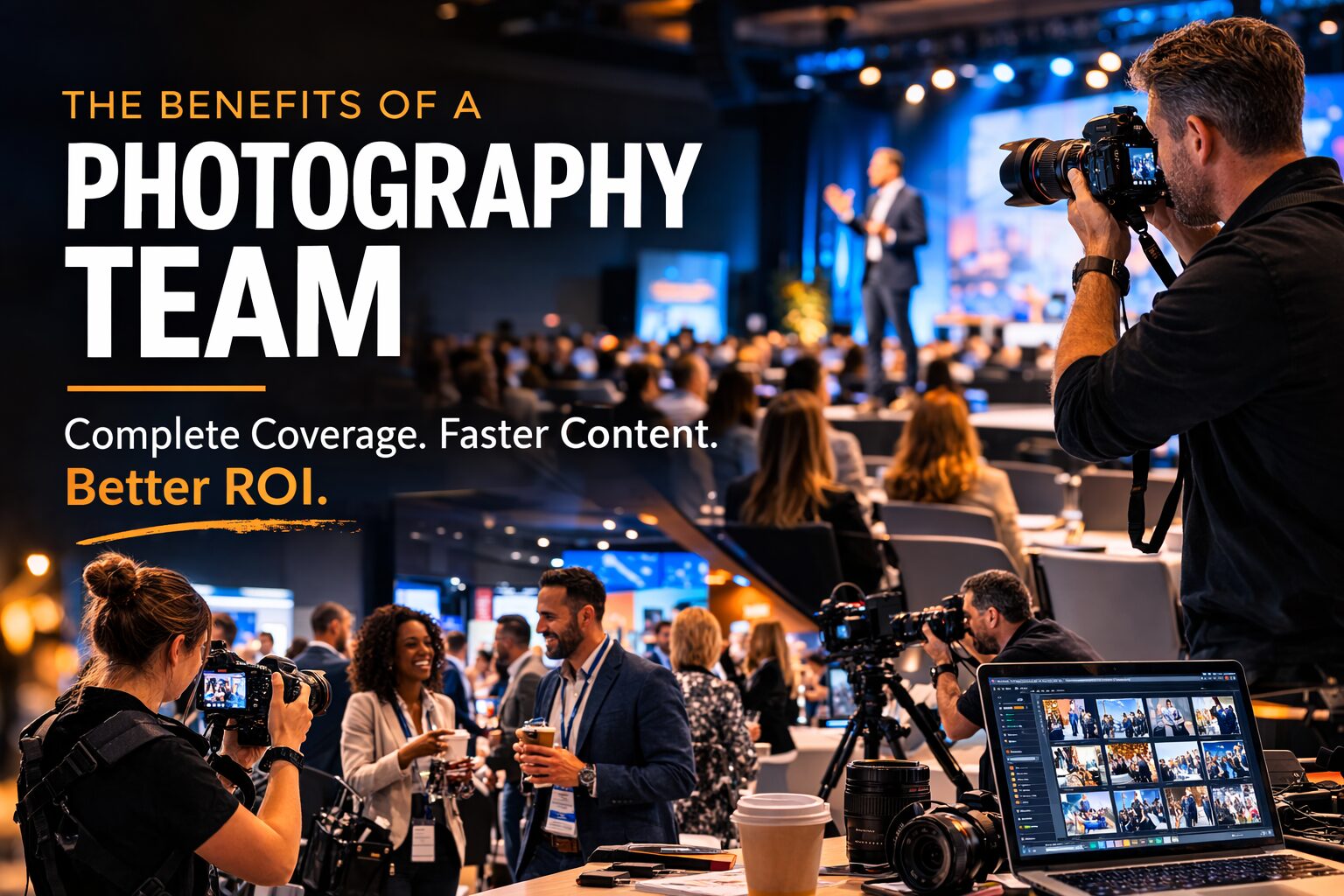
At small events, one strong photographer can often capture everything that matters.
At large events—conferences, summits, multi-track meetings, expos—that approach usually breaks down.
If your event has multiple conference rooms, simultaneous sessions, sponsor activations, VIP movement, and networking happening at once, one photographer simply can’t be in two places at the same time. And when coverage gaps happen, they’re not just creative losses—they’re marketing, sponsorship, and reporting losses.
For event planners and marketing teams, using multiple photographers isn’t a luxury. It’s a strategy for complete coverage, faster content delivery, and better ROI.
The Core Problem: Parallel Moments
Large events are built around concurrent experiences:
- Keynote in the main room
- Breakout sessions in side rooms
- Sponsor activations in expo areas
- VIP meetings and hallway networking
- Awards, press moments, and behind-the-scenes operations
Each moment matters to a different stakeholder. With one photographer, every choice means missing something else.
Why Multiple Photographers Matter
1) Complete Multi-Room Coverage
When sessions run in parallel, assigning photographers by zone or track ensures each room gets meaningful coverage instead of random drop-ins.
Result: Every session has usable assets for recaps, speaker follow-ups, and social content.
2) Better Storytelling Across the Entire Event
One person often captures a narrow thread of the day. A team captures the full narrative:
- Main stage energy
- Session-level depth
- Audience engagement
- Sponsor value in action
- Community and networking moments
Result: Your recap content feels complete, not pieced together.
3) Stronger Sponsor ROI Documentation
Sponsors don’t just want logo photos. They want proof of interaction, traffic, and engagement.
With multiple photographers, one can focus on sponsor deliverables while others cover programming.
Result: Better post-event sponsor reports and easier renewal conversations.
4) Better Coverage of VIPs and Executives
At large events, leadership appearances and high-value introductions happen quickly and often outside the main stage flow.
With a team, you can dedicate coverage for:
- VIP arrivals
- Speaker green room moments
- Executive networking
- Media/photo-op windows
Result: Fewer missed high-value moments.
5) Faster Same-Day Content Turnaround
Modern event marketing runs in real time. Teams need images during the event, not just after.
Multiple photographers can stagger uploads and selects throughout the day, allowing:
- Live social posting
- Midday recap content
- End-of-day highlights
Result: Higher engagement while audience attention is hottest.
6) Better Risk Management
Single-photographer coverage creates a single point of failure:
- Illness
- Delays
- Equipment issues
- Location bottlenecks
A multi-photographer team adds resilience and redundancy.
Result: More reliable coverage under real-world event conditions.
7) Higher Creative Quality Under Pressure
One shooter running nonstop across a venue has less time for composition, lighting, and intentional storytelling.
A distributed team can work more deliberately:
- One captures hero stage moments
- One captures candids and networking
- One captures details and sponsors
Result: Better consistency, better variety, better final library.
How to Structure Multi-Photographer Coverage
A practical staffing model:
- Photographer 1: Main stage + keynote + awards
- Photographer 2: Breakout rooms / workshops
- Photographer 3: Expo floor + sponsor activations + networking
- (Optional) Photographer 4: VIP/editorial + same-day selects support
You can scale this based on venue size and number of simultaneous tracks.
Pre-Event Planning Checklist
To get full value from multiple photographers, align on strategy before event day:
1) Define outcomes
- What channels need assets? (social, email, PR, web, sales)
- What sponsor commitments must be documented?
2) Map the venue into zones
- Main ballroom
- Breakout rooms
- Expo floor
- VIP/media spaces
3) Assign ownership by photographer
Avoid overlap confusion and coverage dead zones.
4) Build a must-capture list
Key speakers, VIPs, sponsors, activations, awards, crowd moments.
5) Set delivery cadence
- Real-time selects
- Midday batch
- End-of-day highlights
- Final edited library timeline
6) Create communication protocol
- Group thread for live updates
- Escalation for surprise moments (celebrity arrival, packed session, sponsor request)
Common Mistakes to Avoid
- Hiring multiple photographers without clear zone assignments
- Over-covering main stage while under-covering sponsors/networking
- No delivery deadlines for same-day social
- No single content owner on organizer side for approvals/prioritization
If you add photographers but not coordination, you get more photos—not necessarily better coverage.
What “Success” Looks Like
After a well-planned multi-photographer event, you should have:
- Full track/session coverage
- Sponsor activation proof sets
- VIP and speaker portrait moments
- Crowd and networking candids
- Brand/detail images for design teams
- Same-day highlights already published
That’s when event photography shifts from documentation to business asset production.
Final Thought
For large events, the question isn’t “Can one photographer do it?”
The better question is: “How much event value are we willing to leave uncaptured?”
If your event has multiple rooms and simultaneous experiences, multiple photographers are one of the highest-leverage investments you can make for planners, sponsors, and marketing teams alike.


Comments